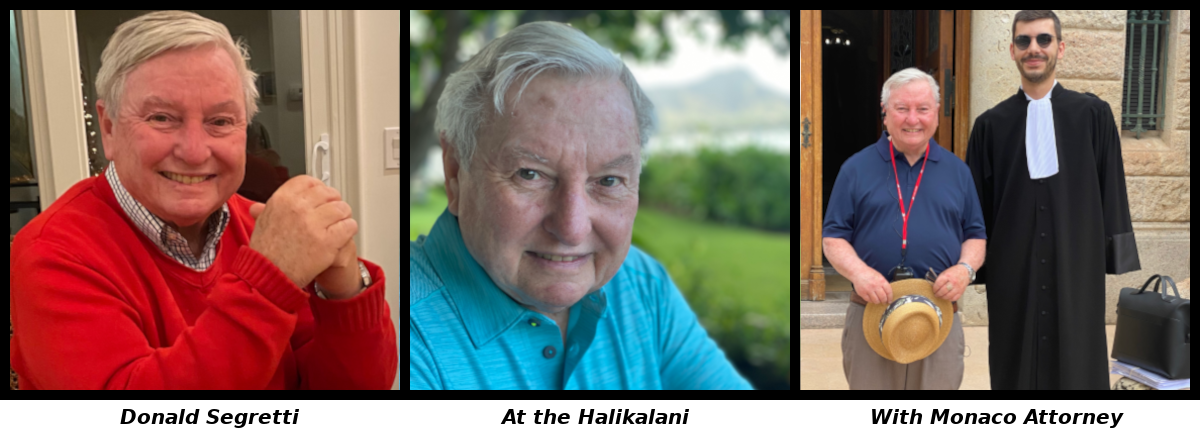
Major Fugh handed the file to me and said “Don, your client is in the Stockade, and you should visit him — tomorrow” It was September 1968, and late in the day.
I had been in Viet Nam two-weeks. My time in the army started in September 1967. I was drafted. It was a year after getting my first job – an entry level position with the Comptroller of the Currency in Washington, D.C. The job didn’t pay much, never enough for an apartment, but allowed for a room up 16th Street away from downtown D.C. It was a very convenient roof over my head as I could take a 20-minute bus ride in the morning directly to the Treasury Building next to the White House. For a young lawyer fresh from law school, it was a heady position – a very small office with another law graduate working directly for the Comptroller of the Currency. Perfect for an undergraduate finance major wanting to go into banking. I passed the California bar. My office mate failed, and he was gone the next day.
It all ended 11-months later with a draft notice. From Lyndon Johnson. That was in 1967-1968 when 50,000 young men a month were being drafted.
Back to California I went, inducted into the U.S. Army at $90 a month – paid cash in a manila envelope. Basic training at Ft. Ord; applied for a JAG Corp direct commission. I was the lucky one out of 20 chosen to be a commissioned as a JAG Captain, and I hoped to avoid assignment to Viet Nam. Private to Captain in the same day. It even made the local Ft. Ord newspaper. My first assignment was to the JAG school in Charlottesville, Virginia. I had no idea what was in store.
I hadn’t taken ROTC in college and knew nothing about being in the Army. I did not know where to pin on my captain bars, or anything about military courtesies or culture. It was war time and I was a 1-day wonder.
Upon reporting to the JAG school building on the edge of the University of Virginia campus I learned S&F on my orders meant that I was now on the staff. I spent a year writing army extension courses, proofing and grading written exams on courses such as Procurement Law, and other fascinating subjects. On occasion I would pinch-hit on teaching courses such as Judicial Punishment and Military Trials for newly appointed JAG officers. I had missed the Introductory Couse, and never saw the mock court-martial for new officers. I would read the course outline a day before the class. It was more like regurgitating the course material rather than really understanding it. I was also writing a law review course for the JAG commandant on use of military force to control riots in our cities – it was 1967-1968.
After 12 months in this cushy assignment, the commandant (a full Colonel) said in passing, “Sorry to let you go to your next assignment.” I acknowledged as if I knew, but my heart was beating faster than normal. I learned later that day I was going to Viet Nam. The army had never told me the priority assignment for an unmarried JAG Captain after one year of service was Viet Nam.
I drove across the country to Los Angeles, and then my parents drove me to Travis AFB to board a plane going to Saigon. The World Airlines charter stopped two times to refuel — once in Honolulu, and then on Guam. I could not avoid noticing the stewardesses (as they were called then) got older with each stop. The long-retired attendants were covering the flight from Guam to Saigon.
Upon arrival I followed the signs to check-in at Tan Son Nhat airport. My first recollections were the heavy humidity, the smell of the Orient, (a combination of camphor wood, spices, and something different but certainly foreign) and the military green “school buses” with heavy-duty large mesh over the windows. I was assigned to the JAG headquarters located in Long Binh, about 20 miles outside of Saigon.
Long Binh was a sprawling American base with 180 miles of roads built for over $100 million dollar with over 1,000 buildings. It was the largest logistical and command center for our troops. The buildings were one-story and two-story – mainly pre-fabs with steel sides. I don’t recall any permanent buildings of stone or brick. The base was so large Army buses had regular routes. It had 60,000 troops stationed there – a temporary American army city. My living quarters was on the ground story modern wooden barrack with other junior officers. Meals were in a modern cafeteria known as the officer’s mess. mess It was a 5-minute bus ride to the JAG office, which was on the ground floor of one of many two-story pre-fab buildings. I didn’t realize it then but the entire base was a protected island from the war. Flares were put up frequently on the parameter, and occasionally we heard rockets explode-but nothing close. Flying low, C-123’s sprayed the base weekly with god know what. The smell of the Orient was gone.
The JAG office was about 2,000 square feet with offices on the window side for the three senior officers – a Colonel, a Lt. Colonel and a Major – and open desks for the seven junior captains and two or three warrant officers. We had three Vietnamese secretaries who spoke various degrees of English. Also assigned was an American court reporter. I remember my Vietnamese secretary, late twenties, abut 5’5” (somewhat tall for a Viet Names) buck teeth, decent English with an accent, and very pleasant. She was quiet, always prompt, never missed a day, and wore traditional ao dai clothing. I have often wondered what became of her.
I was introduced to Major John Fugh, my superior. He was a soft-spoken Chinese American, with pleasant features, about 5’11” medium to slight build. He wore glasses and gave the impression of someone you would find on a college campus – not in an Army uniform 10,000 miles from home. More about John Fugh later.
The walls were light gray, almost off-white, and desks and other furniture were plain government issue – light gray with a soft gray material for desk tops. Not wood, not metal, but of a firm pliable substance. It was before computers; and surprisingly for a JAG office there were no case books. Our reference library was a one-volume Uniform Code of Military Justice. Each of us had one with our name imprinted in “gold leaf” on the out-side of the maroon simulated leather cover.
It was now early September 1968. There were 500,000 U.S. troops in country, and Johnson/McNamara were drafting 50,000 young men a month to feed the war.
After getting my case file for Major Fugh, I took a bus to the Long Binh stockade – known as LBJ. It was a cluster of some 25 to 30 large tents, about 2 dozen connext containers (steel boxes about 15 x 18 feet in size, with a large steel door on one end, and a couple of small windows cut into the sides). There were a several administrative buildings about 25 to 30-feet in size linked together. Likely trailers shipped by home. The connext containers were used as solitary cells for the most difficult prisoners, and those on longer pre-trial periods of detention, Because of the heat the doors were almost always open.
About two weeks before I arrived, after Tet offensive, there had been a violent upraising at the stockade. The stockade held soldiers who were serving short sentences before being sent back to the field, as well as soldiers who had been convicted of serious crimes and were waiting to be shipped back to the army prison at Ft. Leavenworth. By early Summer of 1968, over half were being held on AWOL charges, and more than half were black. Originally built to house 400 inmates, by July 1968 there were more than 700 men.
Close to midnight on August 29, 1968, a group of black inmates overpowered the guards, and started tearing down the stockade. The administrative buildings, where all the records of the incarcerated soldiers were kept, was burned to the ground. Guards were terrified. They were attacked and severely beaten, several were sliced with razor blades inserted in plastic tooth brushes and used as weapons. Very hasty and dangerous.
The guards called base headquarters for help, and two companies (about 400 men) of combat infantry were ordered out and they surrounded the stockade. Their orders were to shoot anyone trying to escape. Nobody escaped. The riot continued for another day with the inmates starting fights among themselves. The whites cowered in one section. However, it was not just racial, and they were just lashing out at anyone or thing. By late in the day of August 30, 1968, 65 soldiers were injured, some severely. One white inmate had been killed. Many guards were injured, and the stockade commander, Lt. Colonel Johnson had been severely cut and beaten.
Peter Arnett covered the story for the Associated press,
“At any point the military could have overwhelmed this group of resisting black prisoners. The decisions were made not to do it. The high command realized the story could grow much bigger; and with the resistance to the war growing at home, they just didn’t want to start drawing even greater attention to this whole racial issue in Vietnam.”
Following, for a two- or three-week period a left-over group of 50 or so black inmates milled around a fenced portion of the stockade by themselves. The number shrank as the days dragged on. The portion of the remaining section was surrounded by a 20-foot high cyclone fence. That section was surrounded 24-hours a day by armed infantry and military police. They set up a surrounding 1000-foot boundary with instruction no person was to get closer without official business. During this time, the military was throwing boxes of c-rations over the fence for the inmates to eat. The remains were scatted over the fenced area. Photos were not allowed.
I had arrived in Viet Nam during this period after the riot. By then, there still remained around 50 young black soldiers milling around the open area. There were no guards inside the fenced area. Small boxes of c-rations were still being thrown over the fence for them to eat.
I recall walking up to the fence and asking for Private Jelks. I only had a thin file on him being held for trial for being AWOL. A solder said he would get him. I recall as clear as yesterday, a short black private walked out of the group and stood about 8 feet from the other side of the fence facing me. He looked at me and in a serious voice said, “So you are my white honkey lawyer.” My answer was, “Yes, and I am all you got.”
After that start – it could only get better and it did. Over the next 2 weeks we began to trust one another. He was not a bad person, but he was in a very bad situation. He was a draftee as I, but from very different circumstances and not wanting to be there. Fifty years later I recall the context – it was 1968 and Martin Luther King has been assignated, the civil rights movant was in full bloom, black areas of cities were in flames, and all that filtered into the atmosphere of American troops in Viet Nam-particular black troops.
Two weeks later, we went to trial before a general court martial panel consisting of a senior officer, two junior officers, and 4 career NCO’s. It was held in one of the modern two-story thin panel steel walled buildings, with a floor of alternative squares of dark gray and white linoleum. This was before military judges were part of the system, before computers with case law being available; or even access to cases on how the law was to be applied. I only had my personalized copy of the Uniform Code of Military Justice – a maroon hard bound book with the criminal military code which governed the procedure and the statutes with elements for each offense. The code was passed in 1950, but had roots in the Articles of War from 1916, and before.
Jelks was charged with mutiny, which carried a possible life sentence. There were no sentencing guidelines; so, the sentence was discretionary if he was found guilty.
Mutiny was defined under the military code as a person, “who intends to usurp or override military authority, refuses, in concert with any other person, to obey orders or otherwise do his duty or creates any violence or disturbances is guilty of mutiny . . . .”
Another section of the same code provision states, “a person who is found guilty of attempted mutiny, mutiny, or failure to suppress or report a mutiny shall be punished by death or such other punishment as court-martial may direct.”
The penalty for the charge was open-ended – and as his defense, I had few options.
The prosecutor was Paul Bible, a more senior JAG Captain, who had tried many cases. Paul was a nice pleasant person, but I wondered why his time in Viet Nam was only 6-months while the rest of us were assigned for 12-month tours; and why he never left the base, or was never sent to other parts of the country for assignments. I learned later his father, Nevada United States Senator Bible, was on the Senate Armed Services Committee.
At 09:30 AM on the day of trial Jelks was brought into the courtroom by three military policemen. Other than my first brief introduction I had spent three other times with him. I had read the file supplied to me and thought carefully about his defense and my arguments. I spent several sleepless nights working on an article in my mind. Do I put him on the stand? Who will Bible put on the stand? The government’s case was not disclosed to me, and not so required.
The trial started about 10:00 A.M. and Bible had two witnesses – one a Sargent who testified that Jelks was in a group of black inmates that were involved in the incident over several hours which resulted in serious injury to the authorities over the stockade, and destruction of LBJ. Another was a lieutenant who was seriously cut-up during the incident by razor blades inserted in tooth brushes. On cross-examination the lieutenant could not identify who injured him.
After lunch, I put Jelks on the stand. It was a big gamble, and we had gone over his testimony during lunch very carefully. He was young, scared, and not that articulate. He had a slight California black accent that I felt could either be for or against him. But the charge depended upon his intent. He testified as we had discussed, that he was just a private, did not plan the incident, did not injure anyone, did not use a weapon, but admitted he was one of those who did not obey to quiet down. I had him clearly testify he did not intend to “usurp or override military authority” and did not so do so in concert with any other person. It was all about intent.
I had some pictures that were taken during the incident, and they showed Jelk standing off to one-side during the incident. Bible objected that it was not relevant, and I did not have the person who took the pictures, and the senior officer appeared as if he was going to uphold the objection. I knew the picture was going to be one of the principal basis of my argument.
Somehow, without a great deal of thought, I asked for a brief break; went into the hallway and called Major Fugh. He gave me advice on how to argue for it to be admitted. After a 10-minutes break, we reconvened, and I argued as Major Fugh had advised. The Lt. Colonel agreed and it was admitted into evidence.
Mid-afternoon I gave my closing argument, that Jelk did not act in concert with others, did not intend to usurp or override military authority, and had no intent to do so – he was just young private that resented being in the military and certainly did not want to be in Viet Nam. He was in the brig and not happy – and he just went along with the disturbance. He testified he had not injured any of the guards.
There was a lesser included offense of riot in which the accused with at least two other members of the group unlawfully committed, “a tumultuous disturbance of the breach of the peace in a violent or turbulent manner.” It was a serious act, but nowhere as serious as mutiny. It carried a maximal 10-year sentence. I argured that if Jelk was guilty of anything it would be bread of peace of which he could avoid prison.
I thought seriously about asking Jelks to pled to such a violation, but thought better of it – as that also required intent. The violation was essentially a breach of peace offense.
I had also introduced with Jelk’s testimony evidence about Private Jelks improvised background, his lack of training by the army, and that he was not a leader or planner of the rebellion.
The trial finished around 4:30 PM. We waited in the courtroom for a verdict. Although there were a few rows of seats in the back, no one else was present except for the armed military policemen. We were on our own; he was facing life in prison with a green lawyer, no sentencing guidelines, and no family or friend to support him. I went over my argument that he was not one of the leaders and was caught up at the moment with no real intent to mutiny. Did I argue strongly enough? I was as nervous as Jelk.
It was tense and quiet. The panel had retired into another room. Jelks and I, along with a court reporter, and the three military policemen were alone in the courtroom. No person said or whispered a word. After a very long time (my memory is 30-45 minutes), the panel returned. We stood up for the verdict. It was for a lesser included offense of riot. He received a 2-year sentence to be served at Ft. Leavenworth, with a dishonorable discharge. He gave me a very strong hug for at least a minute, and we both had tears in our eyes. He whispered in my ear, “You just saved my life.” He was led away.
That was my first trial. Yes, it was justice in a sense, but to assign a green, inexperienced and untrained defense lawyer to defend a man facing life, with a much more experienced prosecutor was not justice by my definition. How many times did such matters go very wrong?
Military justice and trials have changed greatly since. There are now military judges (a separate section of the JAG Corp), who are trained and commissioned Judge Advocate lawyers, a prosecution division, and a defense division – so trials are conducted by more seasoned and knowledgeable counsel. There are now computers so case law can be used. Sentence guidelines are used.
The above are the highlights of my first 4 months in Viet Nam. The second part of my Viet Nam story is to follow. As a preview my next months in Viet Nam included being aide traveling to every army division, HQ’s with the 2-star Judge Advocate General of the Army visiting from Washington D.C., = some murder trials, some very dicey assignments, and seeing first-hand the real war in Viet Nam.
I finished my 12-month tour in Viet Nam in Chu Lai with the Americal Division, received a Bronze Star, an Army Commendation Medal, an Air Medal; and lots of trial work under my belt. I completed my remaining two years in the U.S. Army as a JAG Captain at Ft. Ord, California.
ASIDE ON JOHN FUGH
John Fugh was born in Peking, China and his family moved to the United States in 1950 when he was 15 years of age. He was from a Manchu noble family. His father was a long-time senior staffer to John Stuart, the president of Yenching University, and United States ambassador to China. John Fugh graduated from Georgetown University in 1957 with a B.S. in international relations. He then went to George Washington University Law School, where he graduated in 1960. He joined the Army JAG Corps in 1961, and made the army his career. He rose in the ranks and became the first general of Chinese heritage in the United States Army. He became the 33rd Judge Advocate General of the U.S. Army as a Major General.
After my tour, I next had dinner with him and his wife at his table in a JAG reunion in Fairfax, Virginia in 2013. There had been 350 JAG’s assigned to Viet Nam from 1958 to 1973.
ASIDE ON PAUL BIBLE
Paul Bible finished his time in the army, moved to Reno, Nevada to practice law, and later become the chairman of the powerful gaming commission in Nevada. I am sure his tour in Viet Nam was on his resume. Things never changed for him.
 California Business and Family Attorney